
Ultrasonic Rhinoplasty: Advantages and Full Process
Discover how piezoelectric technology has revolutionised rhinoplasty, offering greater precision, less swelling and a faster recovery.

Ultrasonic rhinoplasty represents one of the most significant advances in nasal surgery over the past two decades. As a surgeon specialising in rhinology in Malaga and Marbella, I have incorporated this technology into my surgical practice because it offers clear advantages over traditional techniques. In this article, I explain in depth what it is, how it works and why it may be the best option for your case.
What is ultrasonic rhinoplasty
Ultrasonic rhinoplasty, also known as piezoelectric rhinoplasty, uses an instrument called a piezotome that emits high-frequency ultrasonic vibrations. These vibrations allow the nasal bone to be cut and sculpted with millimetre precision, without damaging the surrounding soft tissues such as cartilage, mucosa, blood vessels and nerves. Unlike traditional methods that employ manual osteotomes, a mallet or rasps, the piezotome works selectively on bony tissue. This selectivity is what marks the fundamental difference between both approaches and provides the advantages we shall analyse below.
How piezoelectric technology works
The piezoelectric principle is based on the ability of certain crystals to generate mechanical vibrations when an electrical current is applied. In the context of rhinoplasty, the piezotome converts this electrical energy into ultrasonic micro-vibrations oscillating between 25,000 and 30,000 Hz. These vibrations can cut mineralised tissue (bone) but do not affect soft tissues. This is because soft tissues, being more elastic, absorb the vibrations without sustaining damage. The result is a clean, precise and controlled bone cut, without the trauma associated with conventional techniques. At our practice in Malaga and Marbella, we use the most advanced piezoelectric tips available, which allow us to perform everything from lateral osteotomies to dorsal refinement with an accuracy impossible to achieve with manual instruments.
Advantages over traditional rhinoplasty
Greater surgical precision
The main advantage of ultrasonic rhinoplasty is the unparalleled precision it offers. The surgeon can sculpt nasal bone gradually and in a controlled manner, removing exactly the necessary amount of tissue. This is especially relevant when working on delicate areas such as the nasal dorsum or lateral walls.
Less swelling and bruising
By preserving soft tissues, blood vessels and nerves, ultrasonic rhinoplasty produces significantly less swelling and fewer bruises than conventional technique. Scientific studies demonstrate a reduction of up to 50% in periorbital ecchymosis formation -- those bruises around the eyes that concern patients so much.
Faster recovery
As a direct consequence of less tissue aggression, recovery is faster and more comfortable. Patients treated with ultrasonic technique at our Costa del Sol practice report less postoperative pain, less pressure sensation and an earlier return to their daily activities.
Lower risk of irregularities
Traditional techniques can leave palpable irregularities on the nasal dorsum, especially in patients with thin skin. Piezoelectric technology allows uniform bone smoothing that minimises this risk and offers a smoother, more natural nasal contour.
Preservation of nasal structure
The ultrasonic approach facilitates preservation of nasal support structures, contributing to more stable long-term results and reducing the risk of late complications such as dorsal collapse or irregularities.
The complete process step by step
Initial consultation and planning
Everything begins with a thorough evaluation in consultation. I analyse the patient's nasal anatomy through clinical examination, nasal endoscopy and, when necessary, computed tomography. We discuss aesthetic and functional goals, and I plan the surgical strategy in a personalised manner. Dra. Fanjul uses simulation software that allows the patient to visualise possible results before the intervention, facilitating communication and helping to establish realistic expectations.
The surgical procedure
Ultrasonic rhinoplasty is performed under general anaesthesia and takes approximately two to three hours, depending on the complexity of the case. The approach may be open or closed, according to each patient's specific needs. During surgery, the piezotome is used primarily for lateral and medial osteotomies (bone cuts), bony dorsum reduction, refinement and smoothing of bony irregularities, and correction of nasal skeleton asymmetries. Work on cartilage and the nasal tip is performed with conventional suture and remodelling techniques, as the piezotome is designed specifically for bony tissue.
Recovery and follow-up
Recovery follows a predictable pattern. During the first week, the patient wears an external nasal splint and may experience mild to moderate swelling. Bruising, if present, is usually minimal. Relative rest and sleeping with the head elevated are recommended. In the second and third week, the splint is removed and most visible swelling disappears. Patients can usually return to their social and professional life. Between the first and third month, residual swelling gradually reduces. The result becomes increasingly defined. The definitive result is appreciated between 6 and 12 months after the intervention, when tissues have reached their final position.
Ideal candidates
Ultrasonic rhinoplasty is especially beneficial for patients who need dorsal hump correction or nasal bridge reduction, present bony asymmetries requiring precise remodelling, have thin skin where irregularities would be more visible, seek recovery with the least possible impact, and need osteotomies to narrow the nasal dorsum.
Important considerations
Not all cases necessarily require ultrasonic technology. When the main changes affect cartilage and the nasal tip, conventional techniques may be equally effective. During consultation, Dra. Fanjul will evaluate your case and recommend the most suitable technique for your goals. If you are considering rhinoplasty in Malaga, Marbella or Estepona, I invite you to a consultation where we can evaluate your case personally. Ultrasonic rhinoplasty has transformed the way we sculpt the nose, and I can help you determine whether this technology is best suited to achieve the results you desire.
Questions or need a consultation?
I'll be happy to help you resolve your doubts or schedule an appointment.
Learn more about rhinoplasty & nose surgery.
Related articles

Rhinoplasty Recovery: Day by Day Guide
A detailed guide on what to expect during each stage of rhinoplasty recovery, with practical tips for an optimal postoperative period.
Read more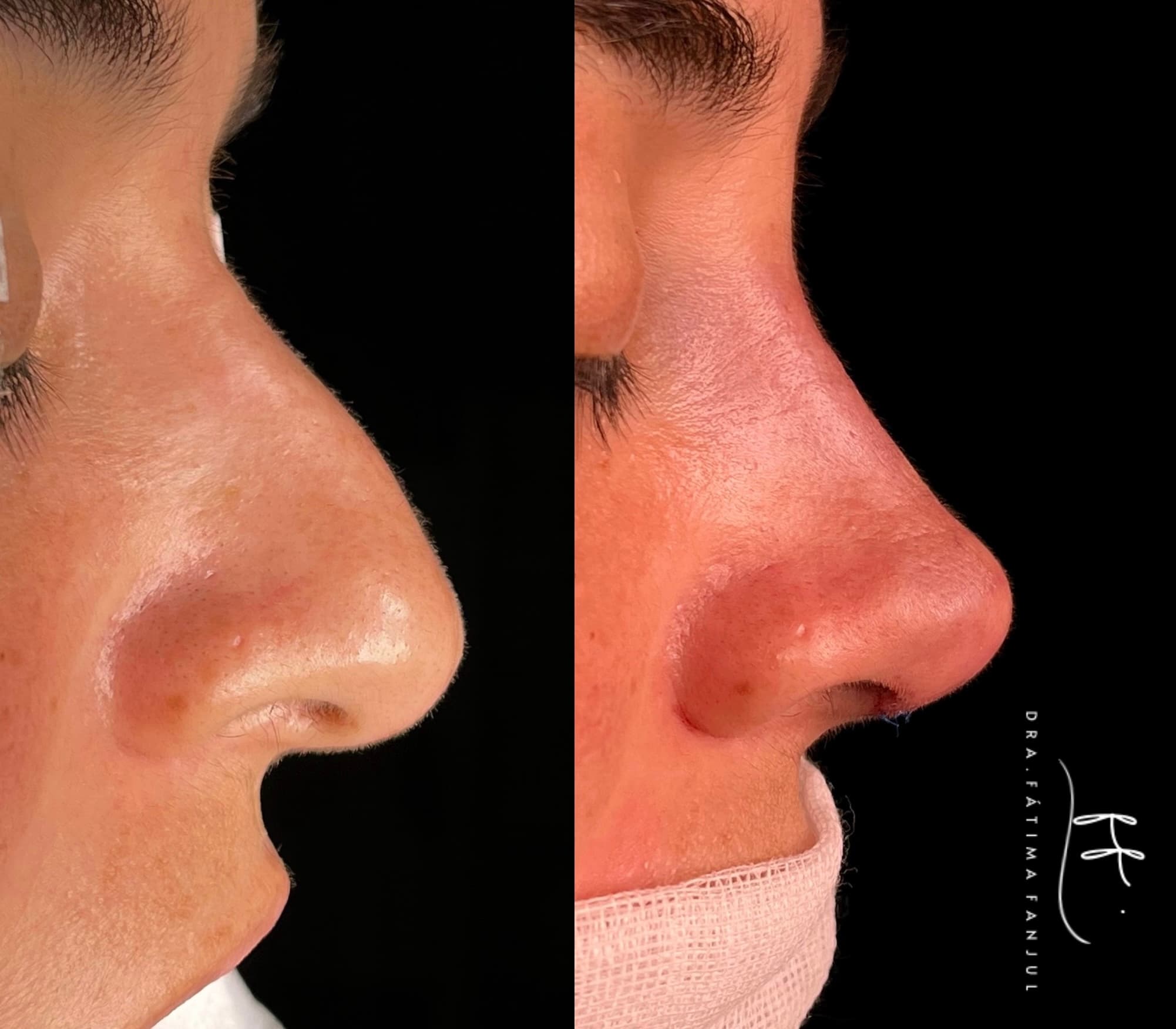
Functional vs Aesthetic Rhinoplasty: What is the Difference?
Discover the key differences between functional and aesthetic rhinoplasty, and how both can be combined for optimal results.
Read more
Rhinoplasty for Men: Special Considerations
Male rhinoplasty requires a specific approach that preserves masculine facial identity. Discover the keys to this procedure.
Read more